
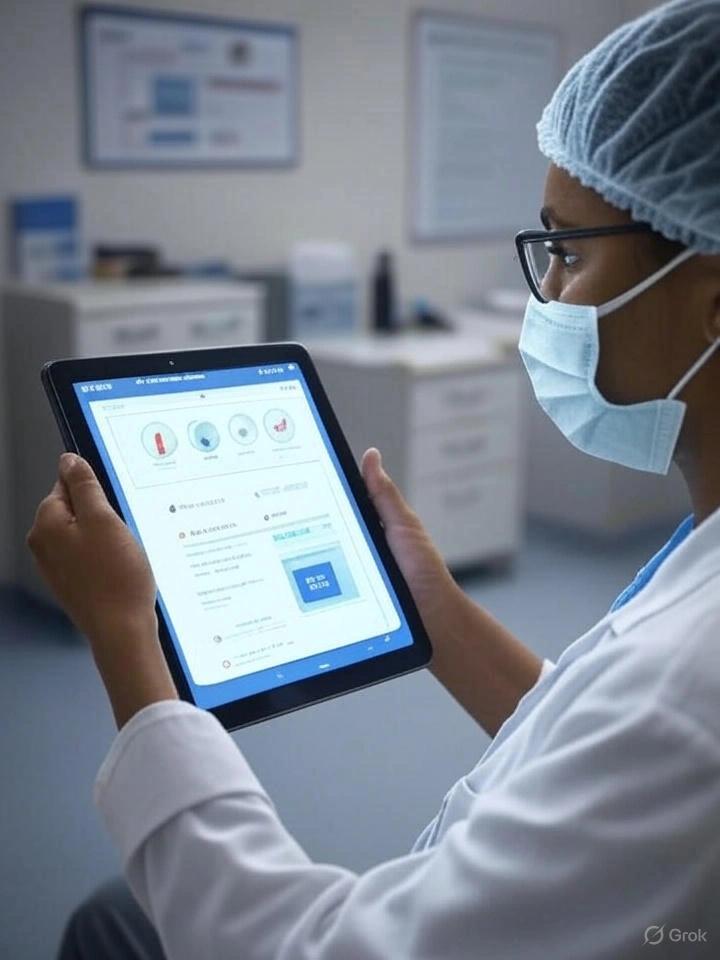
Training on ICT for HIV/AIDS Surveillance and Reporting
Learn how ICT strengthens HIV/AIDS surveillance, reporting, and decision-making in health programs.
Next intake
20 Jul 2026 · Nakuru
Duration
5 days
Live instruction
Delivery
Physical + Virtual
Cohort based
Level
Intermediate
Working professionals
Certification
NITA reimbursable
For Kenyan cohorts
Language
English
All materials
About this programme
Information and Communication Technology (ICT) plays a vital role in strengthening HIV/AIDS surveillance, monitoring, and reporting systems. This course equips health professionals, program managers, and ICT practitioners with practical skills to design, implement, and manage digital solutions that improve HIV/AIDS data collection, reporting, analysis, and decision making.
Participants will explore the use of digital health platforms, mobile health technologies, electronic reporting systems, and data visualization tools to enhance the accuracy, efficiency, and timeliness of HIV/AIDS surveillance and program management.
Duration
5 Days
Who Should Attend
-
Public health officers and program managers
-
HIV/AIDS surveillance and monitoring specialists
-
Health information system (HIS) professionals
-
ICT specialists in health programs
-
Donor and NGO staff involved in HIV/AIDS program reporting
-
Policy makers and health administrators
What you'll walk away with
By the end of this course, participants will be able to:
-
Understand the role of ICT in HIV/AIDS surveillance and reporting.
-
Apply digital health tools for data collection, monitoring, and analysis.
-
Integrate mobile and web-based platforms into HIV/AIDS data systems.
-
Ensure data quality, privacy, and security in reporting systems.
-
Use dashboards and visualization tools for evidence-based decision-making.
-
Align ICT-based surveillance with global and national health standards.
What we cover, module by module
Module 1: ICT in HIV/AIDS Surveillance
-
Overview of ICT applications in health surveillance
-
The importance of ICT in HIV/AIDS monitoring and reporting
-
Case study: Improving HIV/AIDS data flow using digital platforms
Module 2: Digital Data Collection Tools
-
Mobile health (mHealth) applications for HIV/AIDS data
-
Electronic health records (EHRs) and HIS integration
-
Case study: Implementing mobile apps for HIV/AIDS reporting in remote areas
Module 3: Data Management and Quality Assurance
-
Ensuring accuracy, completeness, and consistency in HIV/AIDS data
-
Data validation and verification techniques
-
Case study: Addressing data gaps in HIV/AIDS surveillance systems
Module 4: Data Visualization and Reporting
-
Designing dashboards for program monitoring and reporting
-
Using analytics to track HIV/AIDS indicators and trends
-
Case study: Using visualization tools for national HIV/AIDS reporting
Module 5: ICT Policy, Standards, and Ethical Considerations
-
National and global HIV/AIDS reporting frameworks (UNAIDS, WHO)
-
Data privacy, confidentiality, and ethical issues in HIV/AIDS surveillance
-
Case study: Applying ICT tools while maintaining patient confidentiality
Where the change lands
Organisation Impact
-
Strengthened HIV/AIDS surveillance systems through ICT integration
-
Improved data accuracy, timeliness, and quality for decision-making
-
Enhanced compliance with global and national reporting requirements
-
Increased efficiency in monitoring, evaluation, and program implementation
-
Better collaboration and coordination across agencies and stakeholders
Individual Impact
-
Improved skills in ICT tools for health surveillance and reporting
-
Greater ability to analyze and visualize HIV/AIDS data for insights
-
Career advancement in health informatics and program management
-
Confidence in managing ICT-based data systems for HIV/AIDS programs
-
Practical experience with case studies and real-world applications
Dates and locations
Upcoming intakes
Every intake is limited to a small cohort. Booking closes when a date fills or three weeks before the start, whichever comes first.
| City | Starts | Ends | Delivery | Book |
|---|---|---|---|---|
NakuruNext | 20 Jul 2026 | 24 Jul 2026 | In-Person | Book |
Kigali | 20 Jul 2026 | 24 Jul 2026 | In-Person | Book |
Accra | 20 Jul 2026 | 24 Jul 2026 | In-Person | Book |
Kisumu | 27 Jul 2026 | 31 Jul 2026 | In-Person | Book |
Johannesburg | 27 Jul 2026 | 31 Jul 2026 | In-Person | Book |
Dakar | 27 Jul 2026 | 31 Jul 2026 | In-Person | Book |
- NakuruNext
20 Jul → 24 Jul·In-Person
Book this intake - Kigali
20 Jul → 24 Jul·In-Person
Book this intake - Accra
20 Jul → 24 Jul·In-Person
Book this intake - Kisumu
27 Jul → 31 Jul·In-Person
Book this intake - Johannesburg
27 Jul → 31 Jul·In-Person
Book this intake - Dakar
27 Jul → 31 Jul·In-Person
Book this intake
Common questions.
Still not sure? Send us a note and a facilitator will get back to you within a business day.
You may also like.
Programmes in the same discipline that participants often pair with this course.
 Hybrid5 days
Training for SACCO ICT Managers: Master strategic planning, cybersecurity, and digital transformation to protect your institution and drive growth.
 Hybrid5 days
Learn AI automation, RPA, workflow design, and chatbot integration to streamline operations, reduce costs, and drive digital transformation.
 Hybrid5 days
Learn AI-driven financial automation with ChatGPT to enhance analysis, forecasting, and workflow efficiency.
Course finder
Find the right course for you
Prefer to talk it through? Send us an enquiry and a facilitator will scope a fit within a business day.
For corporate teams
Training 10+ professionals?
We deliver Training on ICT for HIV/AIDS Surveillance and Reporting in-house at your offices, at a venue we arrange, or fully virtual. Customise the curriculum against your KPIs, and get a bespoke price for the cohort size you need.